
written by NOA DIAMOND. August 29th, 2020
Crisscross-applesauce was the first sign of something wrong. My 1st grade teacher noticed me complaining of knee pain during circle time and let me sit in a chair while the other kids stayed on the carpet staring at me, wondering why I was getting special treatment. But we didn’t really think much of it. After all, it’s not really life-changing to not be able to sit crisscross-applesauce.
But the pain continued. For years I searched for answers from dozens of doctors but came up with nothing.
Then, in 2013, I stepped foot into Dr. Allen Letgolts’ office in Brentwood, CA and my life was changed forever.
Recently named the best Physical Therapist in Los Angeles, Dr. Letgolts was the first person who fully believed my pain was real, offered some explanation as to its causes, and even better, helped bring me relief. After just a few sessions, my pain became more manageable on a day-to-day basis. While most of his patients will see him for a finite time and move on, my situation will require lifetime of management, so I visit him whenever I’m home from college.
At my last visit, I told Dr. Letgolts’ about The Dish, and he offered his time to sit down with me to answer some of the most frequently asked questions about the body. There are many exercises and tips that every person could benefit from so here’s to hoping this helps. And thank you to everyone who submitted questions!
- When are you supposed to use heat versus ice for an injury?
If you have acute inflammation (sprained ankle, swelling, stubbed toe), use ice. Swelling occurs from damaged blood vessels and applying something cold causes blood vessels to constrict which reduces swelling. If you just exercised and are feeling inflamed, use ice on those specific areas. On the other hand if you have chronic stiffness and you are trying to improve your mobility, use heat so that when you move you are not irritating the joints. As a more general rule, some people may respond better to one or the other for all types of injuries. If that is the case, experiment with using ice or heat for different injuries and see what offers more relief.
- Why is neck tension so common and what are ways to find relief?
Most of the time, tension in the neck is just a symptom of an underlying problem. For some people it is a posture issue because they are sitting in a position that makes their neck tight while working all day. This can be alleviated by changing the position you hold your head in while at a desk. Being mindful of your posture is important. Check if your laptop is positioned too low for your eyes. That may be causing you to look down and strain your neck. Remember that if a root issue is not addressed, whatever stretches you’re doing for relief won’t make a difference.
For others, neck tension comes from clenching their teeth or grinding at night. A way to manage those symptoms would be by improving the mobility of your upper back which decreases the strain on your neck. This can be done with very simple yoga poses and stretches like doing child’s pose each day. If that doesn’t help the issue, you may want to look into a mouth guard to prevent grinding.
- Is it important to stretch before or after a workout?
If you are doing resistance work or heavy weight-lifting, a lot of stretching won’t be beneficial. A warmup is all you need. If you tend to be stiff or tight, then a gentle stretch can be good on top of that. But, research has shown that aggressive stretching before lifting can make you more prone to injuries.
If you are doing more range of motion types of workout, then stretching before the workout makes the most sense. But it also depends on how tight you are to begin with. Some people might not need to stretch at all beforehand, while others who tend to be tight in certain areas or tight in general will benefit from stretching before.
In regards to stretching after a workout, the necessity depends on the type of workout. If you just spent an hour swimming, no need to stretch. If you are doing heavy lifting, gentle stretching is all you need because as you recover you will tighten up anyways and likely need to stretch later. For other types like cardio and pilates, a cool down at the end with a stretch will be beneficial for avoiding future stiffness.
- What are the differences between using your own body weight vs lifting weights for a workout?
Using your own body weight is much more functional. It engages muscle groups in a more effective way that will make your body more stable. However, it is harder to do your own body weight workouts effectively because it requires a higher coordination of multiple muscle groups. It will also be harder to put on muscle mass.
If your goal in working out is to improve strength and muscle mass, supplementing workouts with resistance and weights is necessary. While it is possible to build up muscle mass with your own body weight, it is harder and may require more time. Resistance workouts allow you to target different muscle groups better and can lead to faster muscle growth.
- What are things we might be doing everyday that are detrimental to our bodies?
There are two main things that come to mind. Sitting a lot and spending a lot of time on the computer in general, especially with a bad setup of where your computer is positioned, is one of the most common reasons for neck and back pain. Not strengthening the extensor muscles (back muscles that help you stand straighter) and the flexor muscles (the ones that pull you forward into a bad posture) is a huge missed opportunity for alleviating general body pain and tension. Start adding simple back exercises and upper body stretches into your routine workouts.
- What advice do you have on how to avoid the dreaded hunchback?
Aside from choosing a family with better genetics, there are two main contributions to a rounded back (hunchback). The first is overall posture related to the feet. Do you pronate, or have flat feet? While this is not something you can’t necessarily fix on your own, looking into getting inserts for your shoes can help tremendously. Everything in the body is connected so if you have issues with your feet, it is likely you will have issues in other places.
The second contribution is poor sitting posture while working. How are you spending the majority of your day? If you are hunched over the computer, you are on a fast track to getting a rounded upper spine. Take frequent breaks when working at the computer and consider getting a standing desk if you are unable to. Also pay attention to your posture while using your cellphone. Many people spend hours each day scrolling on their phones looking like a caveman. Spending hours in a hunched position looking down at your phone will lead to a hunchback.
- Is it possible for people to massage themselves effectively for tension relief?
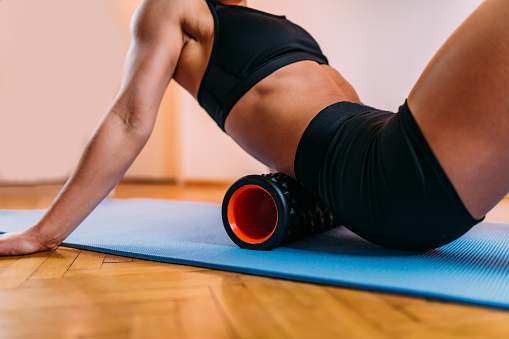
There are not many ways we can massage our own upper backs effectively. Foam rollers are helpful in massaging certain parts of the body (legs and hips). But for the upper body, there is not much we can do for ourselves. There are, however, plenty of stretches we can do for the upper body to help relieve some of that tension. Note that it is important to pair active movement that requires a full range of motion with the stretching to reinforce the benefits of the stretch.
For example, if you stand in a door frame and put your arms up and step forward into a small lunge, you can stretch out your chest/upper back, but that is a passive stretch. Meaning it will feel good in the moment, but that feeling won’t last you that long. If you take the extra step to move your arms around in their full range of motion after that stretch, it will be reinforced and it will last you a lot longer.
- What is the difference between going to a chiropractor and a physical therapist?
Chiropractors have great techniques for getting your joints to move. But, getting your joints to move without addressing why the joint stopped moving is about addressing the symptom, not the cause. This will not produce long-term benefits, only temporary relief. There is no such thing as a stand alone stiff joint. Usually with joint stiffness, the muscles, connective tissue, and central nervous system are all involved. Unless you address all three, that is a very short-term solution for the problem.
Physical therapists tend to address all three. A good PT will also figure out why a joint becomes stiff or painful. They will look at your body as a whole and work on the root of the cause to ensure the other symptoms don’t come back again and again.
- What is something everyone should, but doesn’t know about the body?
One of the most important things Dr. Letgolts considers in his practice that most people don’t realize is that the body compensates. When we face any kind of difficulty with movement or have any type of imbalance, the brain tries to get around that struggle to allow you to function and move as normally as possible. Then we end up developing compensations subconsciously. Most people live with all kinds of compensations they either don’t know they have or don’t know how they developed. Even though in the short-term compensation is essential to be able to function (think limping when you have a hurt ankle), in the long-term this can cause tissue overuse and damage. It is important to identify the original injury or problem that is causing you to compensate in other ways. You might have hip pain and think you have an injury there, when really you have hip pain because you have a knee problem and your body is compensating by adjusting the way you walk and putting extra strain on your hips to help out your knees.
- Can you briefly describe your specific method deemed The Letgolts’ Method?
The Letgolts’ Method is all about looking at your body as a whole system. By looking at the whole body we can see why the injury occurred, which is very often far removed from the injury itself. This requires addressing multiple issues at the same time. The key to The Letgolts’ Method is a thorough diagnosis. If we can’t understand why something happens then we can’t address the underlying problems that will stop the issues from happening again.
 whats-the-dish.com